
Logistics DX & Robotics | Our Strengths
Leveraging operational design and system development capabilities to
deliver stably operating "Robot Warehouses"
A dedicated LT team supports implementation from the ground up
In recent years, hot buzzwords such as "Logistics DX (Digital Transformation)" and "robotics" have been generating a great deal of excitement in the logistics market. As they are promoted as being able to address labor shortages, improve operational productivity, and speed up situational awareness (advancing "visualization"), it is likely that many companies are planning new investments. However, jumping in carelessly is dangerous. If the method of implementation is wrong, the latest technology can end up being nothing more than a white elephant.
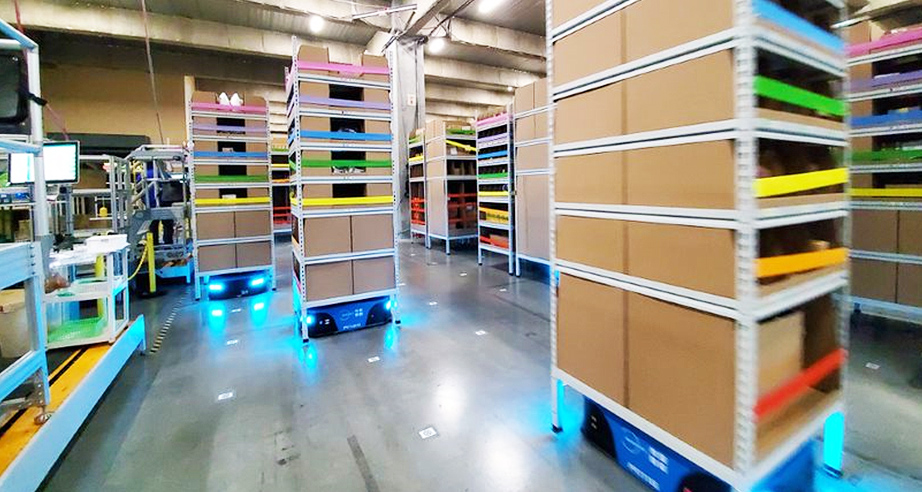
What is essential for logistics sites to deliver their maximum performance through the implementation of logistics DX and robotics is operational design capability and system development capability. In other words, the ability to handle the groundwork needed to make the machines run. Meito has a dedicated team that researches, develops, and implements new LT (Logistics Technology), and this group of professionals has established a framework to build "state-of-the-art systems" tailored to our customers' business, product, and merchandise characteristics as well as industry practices, starting from square one.
Robot storage, shelf-transport robots, AGVs and more
extensive operational track record at our own logistics centers
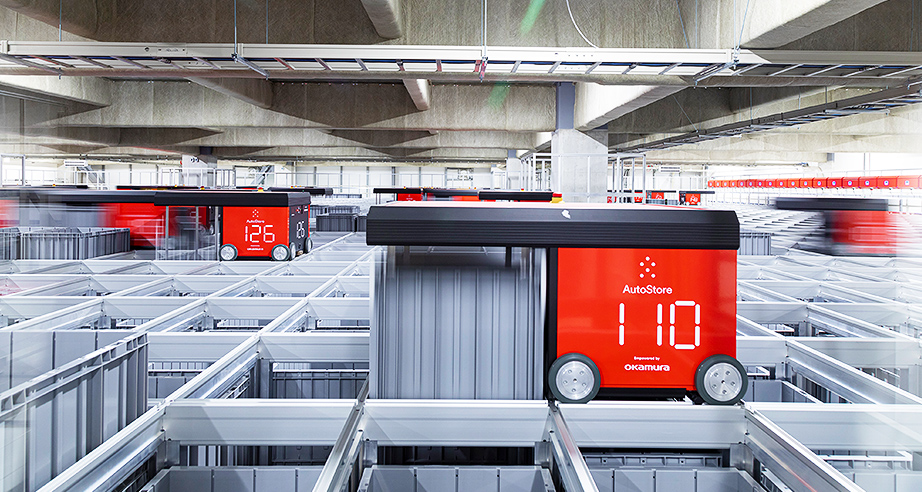
We have also steadily built up a track record in logistics DX and robotics. For example, "Logistics Center Yokohama Kanazawa," which opened in October 2021. At this center, which mainly provides 3PL services for mail-order businesses, we have installed two units of the "AutoStore" robot storage system. Rather than leaving everything to vendors, we adopt a style in which Meito develops and implements the latest systems and material-handling equipment with our own hands, achieving automation, labor savings, and space savings at the logistics site.
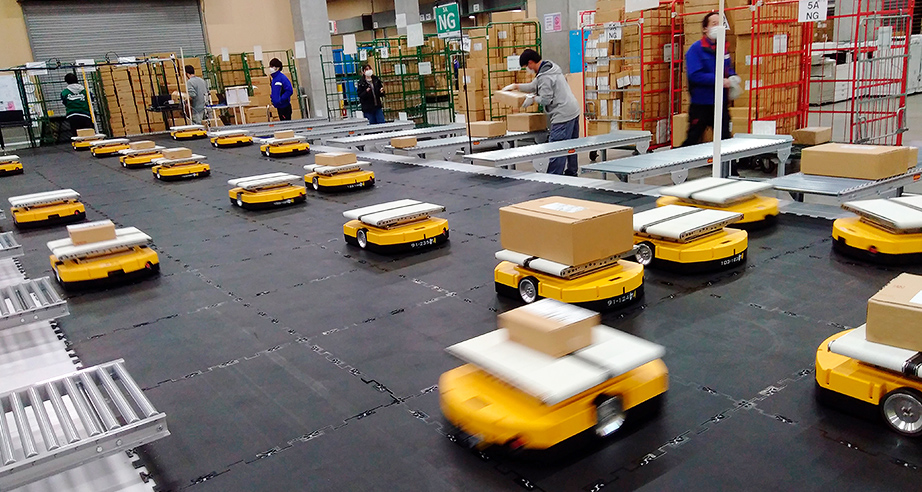
That is not all. At "Logistics Center Saitama," we have introduced "shelf-transport robots" that reduce the amount of walking required of picking staff. At "Logistics Center Kanto," by adopting a "robot sorter" for last-mile sorting operations, we have achieved a framework that can flexibly adapt to future prospects and volume fluctuations through flexible layouts and by increasing or decreasing the number of robots. Furthermore, on the premises of "Logistics Center Yokohama," we are accelerating the roboticization of logistics sites, such as utilizing AGVs (Automated Guided Vehicles) for electronic-component logistics operations. Going forward, we also plan to introduce "picking-assist robots (AMR)" and "high-rise automated case-handling robots," among others.
Opening a dedicated DX & Robotics laboratory
We have opened a dedicated laboratory with the aim of sharing the knowledge accumulated by each company across the group, accelerating the utilization of ever-evolving cutting-edge LT, and achieving early, stable operation.
The activities carried out at this facility are wide-ranging, including functional evaluation of various solutions, collection of validation data and effectiveness evaluation of the warehouse management system (WMS) and the group of solutions integrated with it, and feedback of improvement and enhancement proposals to manufacturers.
Currently, we are conducting verification work on solutions for the Meito Group's EC-dedicated center, which is scheduled to begin operation in the near future. In addition, we are establishing an environment in which existing and prospective customers considering the introduction of Meito's robot solutions can feed the order information for their actual products into real robot solutions and run tests.
At the Meito Group, going forward the LT Planning Department, where each company's LT specialists gather, will continue to lead verification work, providing continuous and stable logistics services.
A selection of our Logistics DX & Robotics implementation examples
AutoStore
(Automated-warehouse-type picking system)
A system in which robots retrieve and store containers held at high density within the equipment. Multiple robots (electric carts) travel across a grid (columns and beams) assembled in a lattice pattern, lifting bins (dedicated containers) stored within the grid and transporting them to ports (picking stations). At the ports, staff pick items out of the transported containers or replenish items into the containers.
Shelf-transport robot
A system in which robots (automated guided vehicles) that travel across the floor of a logistics facility slip beneath a shelf, lift it up, and carry it to the location where work staff are stationed. Because staff store items on or pick items from the shelf that the robot has brought right in front of them, in principle no walking occurs. There is also no risk of mistaking which shelf to store into or pick from, improving work accuracy.
Robot sorter
A system in which, once an item (product) is placed on the tray atop a robot (automated guided vehicle), the robot travels on its own to a pre-registered chute (opening), then tilts the tray to sort products automatically. Whereas manual sorting requires work staff to walk to each chute, the robot sorter has robots travel on their own and sort products in a seed-sowing manner, achieving speedy processing and reducing the workload.
AGV (Automated Guided Vehicle)
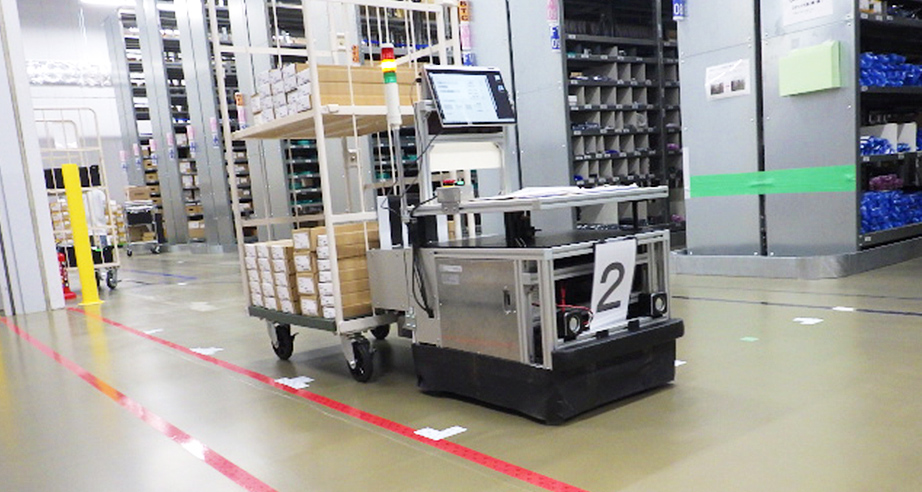
A transport cart that runs unmanned without human intervention. By using it to move goods within a logistics center, it achieves labor and manpower savings. While adoption at manufacturing sites such as factories came first, in recent years adoption at logistics sites has also been advancing with the aim of reducing the work burden and addressing labor shortages.
AMR
(Picking-assist robot)
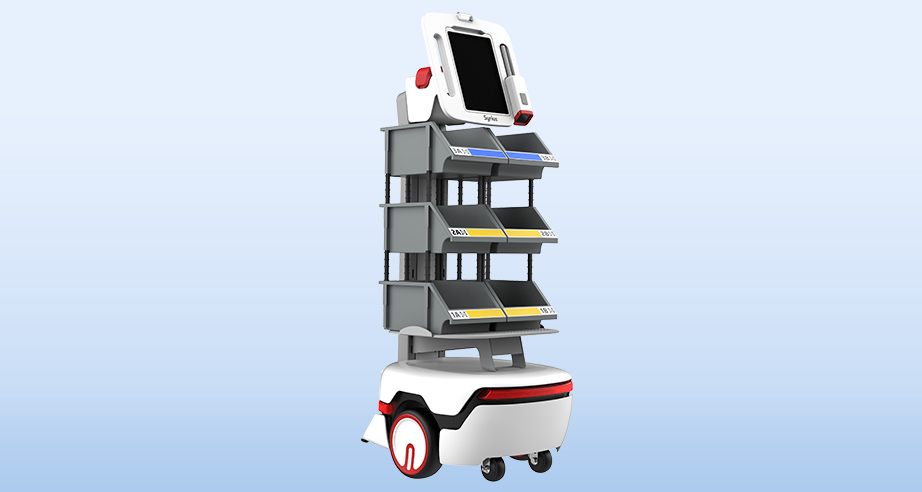
A system in which a picking cart travels on its own to the rack where the products to be picked are stored. When work staff pick the relevant product from the arrival point (location) of the self-traveling cart and place it in the cart, the cart moves to the next picking point. With conventional cart picking, work staff had to walk through the area together with the cart, but with AMR the cart travels on its own, so it is enough simply to station work staff in each zone.
ACR
(High-rise automated case-handling robot)
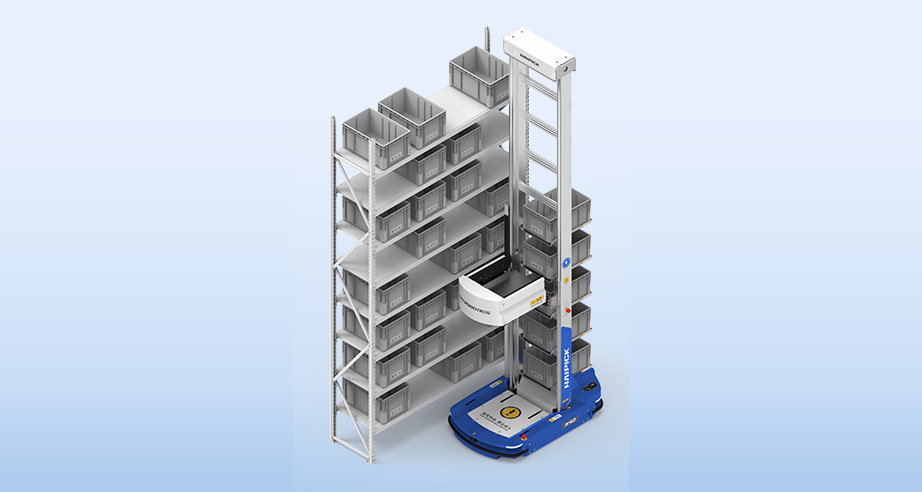
A system that can automatically retrieve and store case products housed in racks. Because it also automatically retrieves and stores case products placed in the high-rise sections of racks, it can ensure greater safety for high-altitude work than manual operations using forklifts and the like, as well as achieve improved storage efficiency. Since operations such as storage and case picking can be made unmanned, it also helps address labor shortages.
Related pages here
Check this out too! Updated monthly!Meito's 'Recommended Warehouse Information'
You can view our most highly recommended logistics warehouses right now here.
Popular ones fill up fast, so don't wait!