


What Is a Supply Chain? A Thorough Explanation with Meaning and Concrete Examples|Our Strengths
Explaining the basic concept and history of supply chains,
their current state and challenges, and the issues of globalization!
A supply chain is a complex process that involves numerous stages across the entire flow of making a product and delivering it to the customer, including the procurement of raw materials, the production of goods, the transportation of products, inventory management, and sales. In such a process, if any stage does not proceed smoothly, problems such as excess inventory, stockouts, production delays, and high costs can arise. This in turn leads to consequences such as a decline in customer service, a drop in product quality, a loss of corporate trust, increased costs, and reduced profits.
In this article, we explain the basic concept and history of the "supply chain"—which is considered extremely important in business—along with its current state and challenges and the issues of globalization, and we also touch on the characteristics of supply chains in manufacturing. In addition, we introduce the supply chain management that our company undertakes.
- What is a supply chain・・・
- What is supply chain management・・・
- What supply chain management can achieve
- The key to supply chain success・・・
- The history of the supply chain
- Characteristics of Japan's supply chains
- The current state and challenges of supply chains
- About the globalization of supply chains
- Supply chains in manufacturing (manufacturers)
- Meito's supply chain management
- Supply Chain Q&A
What is a supply chain・・・
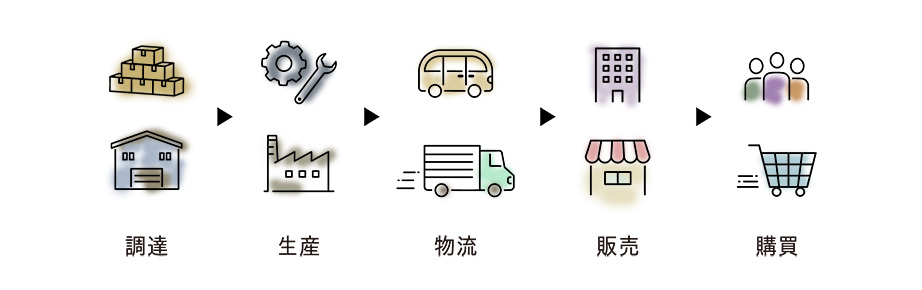
Goods (products) are generally supplied to the market after going through the processes (stages) of procurement, production, and sales. For example, in the case of beer, a manufacturer procures raw materials such as malt and hops, as well as materials such as aluminum cans and glass bottles, from its suppliers, produces the beer at a factory, and then sells it to wholesalers. The wholesalers in turn sell it to food and beverage establishments (such as restaurants) and to retailers such as supermarkets and convenience stores, and consumers purchase it in store.
This entire flow is called the "supply chain." The word "supply" is joined with "chain" because of the idea that the processes of procurement, production, and sales are interrelated and connected to one another. In Japanese, "supply chain" is sometimes expressed as "供給連鎖" (literally, "supply linkage").
What is supply chain management・・・
Traditionally, many manufacturers calculated their factory production volumes based on forecasts made by the wholesalers and retailers responsible for the sales function, such as "next month they will probably purchase (order) about this much." Based on this production plan, the manufacturer procures (orders) the raw materials and supplies needed for production, while the suppliers who provide those raw materials and supplies determine the quantities to prepare based on the manufacturer's forecast of "next month they will probably purchase about this much." Retailers order from wholesalers based on the projection that "next month about this much will sell in store," and wholesalers likewise order from manufacturers based on the projection that "next month the retailers will probably order about this much."
When procurement, production, and sales each place orders based on such projections in this way, wasteful inventory of raw materials, supplies, and finished products arises whenever the demand forecast is wrong. Holding excess inventory requires costs to manage (store) it. Furthermore, if discount sales are carried out to clear excess product inventory, profits will naturally decline.
In contrast, if suppliers who provide raw materials and supplies can know the accurate production plan (production volume) of the manufacturer they deliver to, they can avoid holding unnecessary inventory. On the other hand, if a manufacturer can obtain the accurate ordering plan of a wholesaler, it can avoid excess production. And if a wholesaler can grasp a retailer's sales plan (planned orders), it can procure without shortage or surplus.
As described above, supply chain management (SCM) is an initiative to make the entire supply chain more efficient by having procurement, production, and sales coordinate with their respective supply partners. Because there are limits to partial optimization within the individual processes of procurement, production, and sales, the aim is to optimize the flow of goods across the entire supply chain.
What supply chain management can achieve
By deploying supply chain management, the following outcomes can be expected.
Inventory reduction
Reducing wasteful inventory such as raw materials, supplies, products, and in-store goods Because orders come to be placed at quantities close to actual demand provided by delivery destinations and others—rather than based on projections—wasteful procurement and production, as well as the hoarding of products to prevent stockouts (on the sales side), are eliminated, making it possible to reduce inventory that stagnates within the supply chain.
Shortening of supply lead times
Shortening the time until goods are placed on the market Because purchasing, production, and procurement can be deployed speedily based on raw data such as actual sales results in the market, the lead time from procurement to production to sales can be shortened. Since products can be supplied in a timely manner in response to market demand, it becomes possible to prevent lost sales opportunities.
Cost reduction
Eliminating duplicated operations to reduce costs The players (companies) responsible for the respective functions of procurement, production, and sales coordinate with one another, making it possible to eliminate duplicated operations such as each party creating its own demand forecast. For example, if a mechanism is built whereby the supplying side automatically replenishes inventory based on the delivery destination's procurement plan, order-less operation can be achieved, leading to a significant simplification of operations.
The key to supply chain success・・・
One of the keys to whether a supply chain functions well can be said to be information sharing. When the companies responsible for procurement, production, and sales are different, it was traditionally nearly impossible—due to the power balance in business relationships—to have business partners disclose and provide planning information on orders, production, and purchasing, as well as sales performance data.
In contrast, supply chain management removes these barriers and, by sharing information with one another, eliminates surpluses and shortages of goods to achieve overall optimization of the supply chain. In fact, the companies succeeding in supply chain operations are those that, based on the idea of being "equal partners," develop close information linkage among multiple business partners.

The history of the supply chain
The concept of the supply chain developed in the early 20th century. Before that, manufacturers carried out the entire process—from producing goods from raw materials to selling them—in-house. However, in the 1930s, manufacturers began to use services provided by specialists to produce their goods. This was the birth of the supply chain, and ever since, supply chains have come to be adopted across entire industries.
In the 1960s, major manufacturers began to introduce supply chain management systems to manage the entire process from product development to delivery. This enabled manufacturers to produce goods more quickly and efficiently in order to meet market needs.
In the 1970s, supply chain management spread not only to manufacturing but also to retail, service, and other industries, and supply chain management came to play an important role across entire industries.
In the 1980s, advances in computer technology made supply chain management systems more complex and sophisticated, enabling the automation of business processes. As a result, supply chain management became more efficient and faster, and manufacturers were able to make better decisions to respond to market changes.
It is said that supply chain management began to spread as one of the management methods of businesses in the late 1980s. The initiative spread mainly among leading Western companies—particularly those known as "manufacturer-retailers," which handle all functions from production to sales in-house or within their own group. Manufacturer-retailers have the advantage that they can complete the sharing of information (data) across the procurement, production, and sales processes internally, making the supply chain easier to manage. Specifically, supply chain management was deployed for products such as apparel and personal computers. In Japan, such initiatives began in earnest from the mid-1990s onward.
Characteristics of Japan's supply chains
Japan's supply chains are known for their high degree of planning, quality control, efficiency, and global reach. Japan has a long history of manufacturing and supply chain management, and it has developed sophisticated systems and processes that prioritize these characteristics.
One major characteristic of Japan's supply chains is the emphasis on planning. In order to respond quickly and efficiently to market demand, Japanese manufacturers plan every aspect of the supply chain process, from product development to delivery. This kind of planning helps them maintain their competitiveness in the global market.
Quality control is also one of the important characteristics of Japan's supply chains. Manufacturers pay meticulous attention to ensuring that the products they make meet high standards, achieving this through various quality control systems. As a result, customer satisfaction improves, and they are able to meet customer demands.
Japan's supply chains are also notable for their efficiency. Japanese manufacturers adopt technology and automation to improve their production and delivery processes, and this leads to effective competition in the global market.
In addition, Japan's supply chains are deployed globally. Japan has been an exporting country for decades, and many manufacturers have built supply chains that span the globe. This gives them access to new markets and customers, and allows them to procure raw materials and components from various regions.
Finally, Japanese manufacturing is diverse, spanning automobiles, electronics, food, and more. This diversity allows Japanese suppliers to adapt to the demands of different markets and customers.
Overall, Japan's supply chains are known for their ability to efficiently plan, produce, and deliver high-quality products. This is what enables them to maintain their competitiveness in the global market and have a strong reach worldwide.
The current state and challenges of supply chains
The current state of supply chains is one of increasing uncertainty and volatility (the degree of price fluctuation). The COVID-19 pandemic has had a major impact on supply chains around the world, disrupting global trade and causing delays and shortages in the delivery of goods. This stems from numerous factors, including supply chain disruptions caused by lockdowns, changes in consumer demand, and difficulties in transportation and logistics.
Another problem currently facing supply chains is the growing trend toward protectionism and trade barriers. As governments around the world adopt policies restricting imports and exports, it is becoming difficult for companies to obtain the raw materials and components needed to produce their products.
In addition, the current global economic situation is affecting supply chains, as companies face financial difficulties and must implement cost-cutting measures, leading to inventory reductions and the curbing of new investment.
Furthermore, climate change and environmental considerations are also affecting supply chains. Companies are being pressed to reduce their carbon dioxide emissions and to source raw materials from sustainable resources. This is difficult, especially for companies that rely on global supply chains spanning multiple countries and regions.
Finally, there are growing calls for companies to raise their social and ethical standards. This includes issues such as workers' rights, human rights, and fair labor practices, which can be difficult to ensure across an entire global supply chain.
In summary, the current state of supply chains is one of increasing uncertainty and volatility due to the COVID-19 pandemic, trade barriers, economic conditions, environmental issues, and social and ethical issues.
About the globalization of supply chains
The globalization of supply chains refers to the increasing interconnection of companies, countries, and regions through the procurement of raw materials, components, and finished products. This interconnection gives companies access to new markets and customers, and also enables them to procure raw materials and components from different regions at lower cost.
One of the factors driving the globalization of supply chains is the reduction of trade barriers and tariffs, which has made it easier for companies to enter new markets and procure raw materials from different countries. In addition, advances in transportation and logistics technology have also played a role in making global supply chains more efficient and cost-effective.
However, the globalization of supply chains also has its drawbacks. As supply chains become more complex, they can become more vulnerable to disruptions such as natural disasters, political instability, and economic downturns. Furthermore, because companies may choose to source from countries with lower standards, there is also the potential for negative impacts on society and the environment, such as labor exploitation and environmental degradation.
Overall, the globalization of supply chains creates both opportunities and challenges for companies. While it has enabled improved efficiency, cost reduction, and entry into new markets, companies are also required to survive in a more complex and uncertain environment and to be more strongly aware of the impact of their own activities on society and the environment.
Supply chains in manufacturing (manufacturers)
A supply chain in manufacturing refers to the process of procuring raw materials and components, processing them into products, and delivering them to the customer. It is an important element that makes up the manufacturing process and includes a wide range of activities such as procurement, production planning, logistics, and distribution.
Supply chains in manufacturing have the following characteristics.
High fluidity
Supply chains in manufacturing need to change quickly in response to the product life cycle and shifts in demand. In particular, in the case of high-tech products, it is necessary to respond sensitively to market trends and technological innovation.
Complex supply networks
In supply chains in manufacturing, there are multiple sources of procurement for a product's components and raw materials, and these are connected across the entire supply chain. Therefore, it is necessary to appropriately coordinate each of the procurement, production, and logistics processes.
The importance of inventory management
In supply chains in manufacturing, inventory exists in various forms at the production stage and the logistics stage. By appropriately managing this inventory, greater supply chain efficiency and improved productivity can be achieved.
Capital-intensive
Supply chains in manufacturing require capital investment in production facilities, machinery, and equipment. In addition, in order to respond to fluctuations in production volume and changes in demand, appropriate adjustment of and investment in production lines is necessary.
The difficulty of demand forecasting
In manufacturing, demand forecasting can be difficult. When demand fluctuations are large or when new products are being developed, it is difficult to improve the accuracy of demand forecasting.
Because of the characteristics described above, supply chain management in manufacturing requires advanced planning and control capabilities. Manufacturing companies are required to take an overview of the entire supply chain and make appropriate strategic decisions.
Overall, the supply chain is an important aspect of manufacturing and plays a crucial role in ensuring efficient and cost-effective production and the delivery of goods to customers.
Meito's supply chain management
The greatest feature of Meito's supply chain management services is that we can provide a range of solutions capable of covering all areas—from procurement to production to sales—in a single, seamless manner.
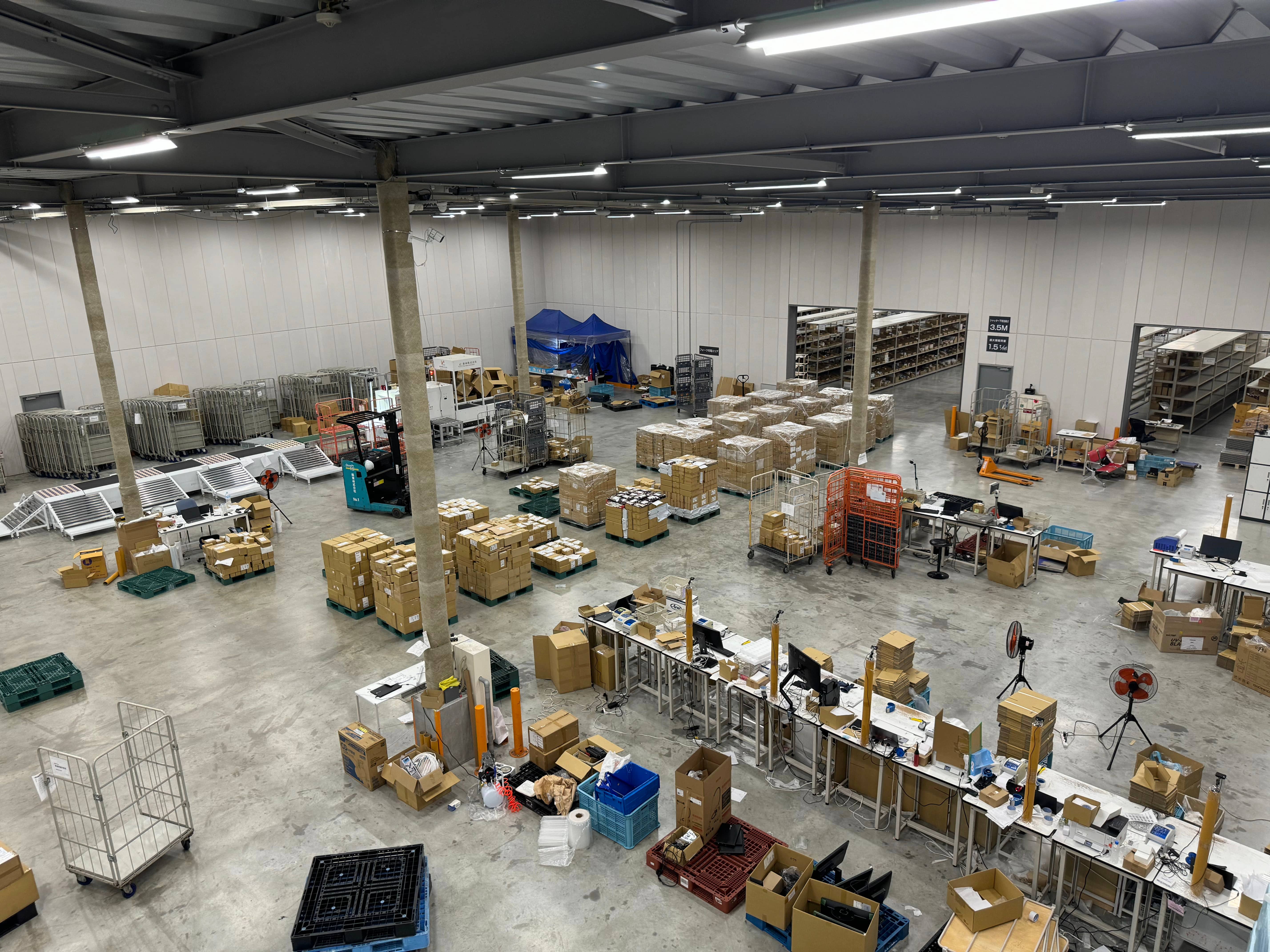
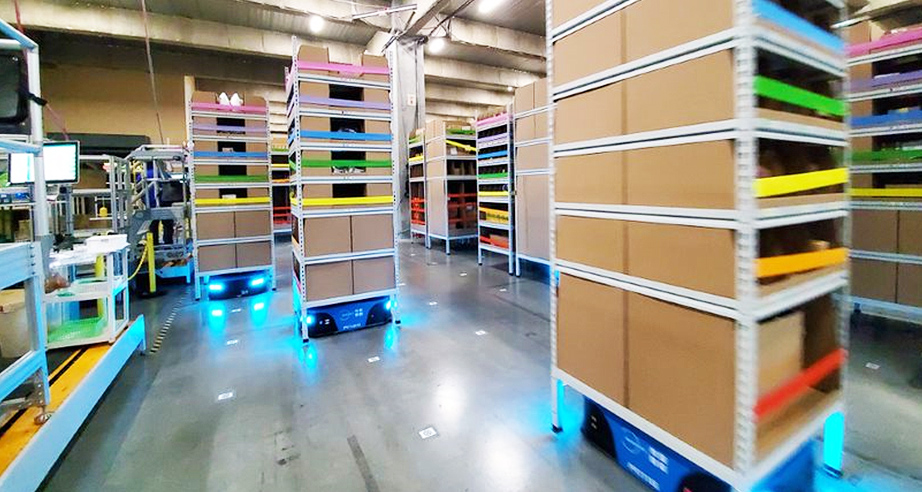
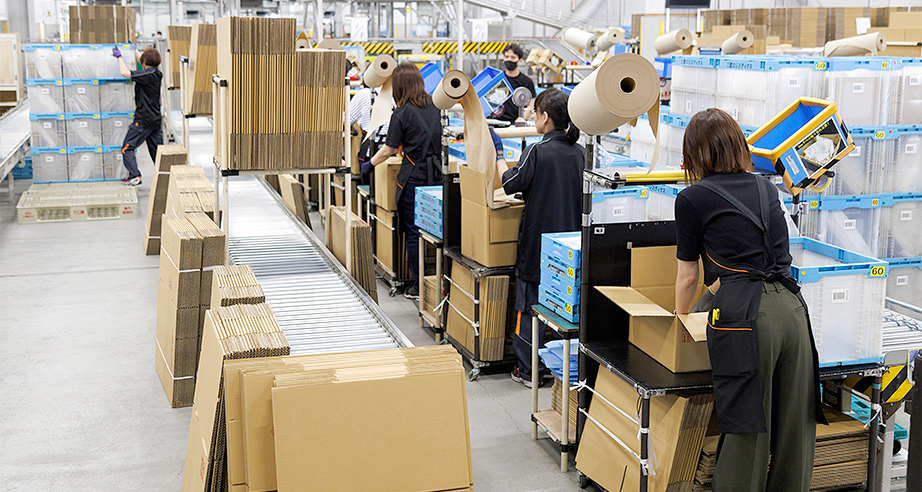
For example, in procurement we perform functions such as placing orders with each supplier on the customer's behalf, managing the inventory of procured raw materials and supplies in VMI warehouses and the like, and supplying the required quantity of raw materials and supplies from the warehouse to the production line at the required timing. In the production area, meanwhile, we handle the temporary storage of assembled and finished products in factory warehouses or external warehouses, as well as transportation and delivery to sales bases. In the sales area, we act on the customer's behalf for operations such as delivery to end users, the installation and setup of fixtures and equipment, and the collection and recycling of used products.
The supply chain management expertise we have cultivated as the logistics subsidiary of a precision equipment manufacturer is now put to use by customers across a wide range of industries and business types. Of course, we are confident in our ability to handle not only domestic supply chains but also global supply chains, and we have abundant experience.
Meito's logistics services
Supply Chain Q&A
However, these processes are closely interrelated, and there are limits to attempting partial optimization within the procurement, production, or sales processes alone. By having each supply partner share information with one another, it becomes possible to achieve overall optimization that eliminates surpluses and shortages of goods.